Translational displacements
The Translational displacements analysis result shows the translation, or movement, of finite element nodes under the current loading or analysis conditions. It represents how the structure displaces in space as a response to applied loads, imposed actions or dynamic effects.
Translational displacements are available for a wide range of analysis contexts, including static, stability and dynamic analyses.
- Load cases – nodal displacements from individual load cases
- Moving load maximum – envelope of maximum nodal displacements due to moving loads
- Moving load influence line / surface – influence results for nodal displacements
- Construction stages – displacements during staged construction
- Imperfections – displacements including geometric or load imperfections
- Load combinations – displacements from defined load combinations
- Stability analysis – displacements related to stability shapes
- Maximum of load combinations – envelope of displacement results from multiple combinations
- Maximum of load groups – envelope of displacement results grouped by load groups
- Eigenfrequencies – modal displacement shapes
- Seismic analysis – displacement response from seismic loading
- Footfall analysis – vibration-induced displacements
- Moving load dynamic – dynamic displacement effects from moving loads
- Time history – ground acceleration – time-dependent displacements from ground motion
- Time history – excitation force – time-dependent displacements from applied forces
- Periodic excitation – steady-state dynamic displacement response
- Storey fundamental frequency – storey-based displacement shapes
Result selection
Depending on the selected analysis context, additional selections are required to display Translational displacements.
One or more of the following parameters may need to be selected from the result lists:
- load case type, such as ultimate or quasi-permanent
- load case or load combination
- displacement component, for example ez+ direction, for envelope-type results
- construction stage
- stability shape
- vibration shape
- seismic shape
- moving load position
- moving load velocity
- time step, for time history results
- storey, for storey-based results
Only the selections relevant to the active analysis type are shown.
Result display
Translational displacements can be displayed using standard result display types:
- Graph
- Colour palette
The available display options depend on the selected analysis context and result representation.
Graph
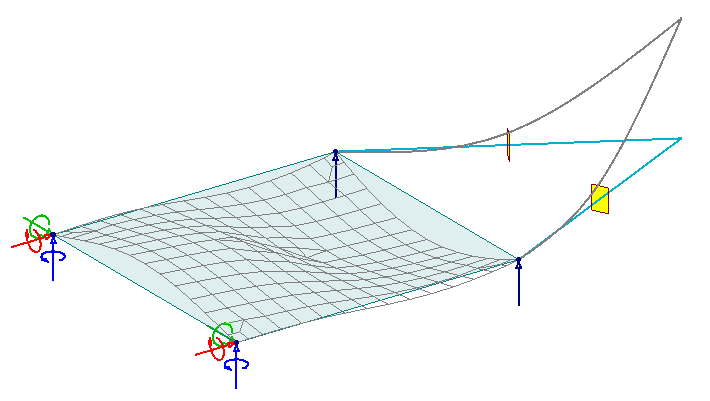
Displacement values shown as deformed shape on shells and bars.
Colour palette
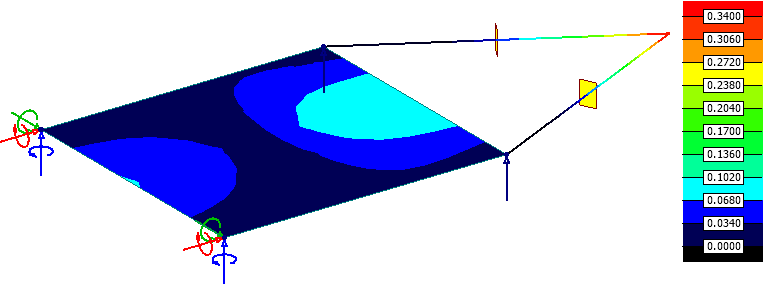
Nodal displacements visualised as coloured fields.