Design checks
Design checks
As a default, PREFAB runs checks for plastic limits, or design checks for shell elements of concrete and steel trusses. The design checks are run on import and vary depending on the chosen calculation method. Here's an example of the utilization check on import:

Here's a quick overview of the design checks:
Walls:
- Compression – minimum of Eurocode (concrete) or plastic limit on edge
- Tension – plastic limit on edge
- Shear – minimum of Eurocode (concrete) or plastic limit on edge
- Sliding – combined shear and compression check
Trusses, Based on FEM-Design:
- Tension of steel – minimum of Eurocode or plastic limit
- Compression of steel – minimum of Eurocode or plastic limit
Trusses, New optimized plastic redistribution:
- Tension and shear of steel – combined check with minimum of Eurocode or plastic limit
Whether the design checks are included in the PDF print can be specified in the settings.
Wall design checks
Plastic limits
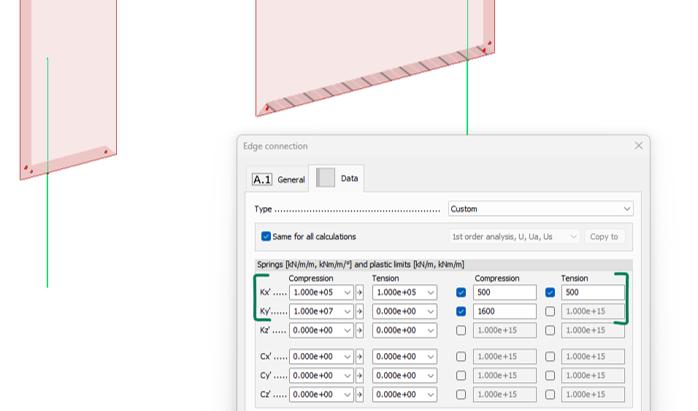
As a rule, PREFAB will always compare the connection forces to the plastic limits defined in the edge-connection properties. If a stiffness value is set to 0, PREFAB sees it as a plastic limit of 0.
For the edge-connection shown below, PREFAB will check the shear (Kx', both directions) against , the compression (Ky' - Compression) against and the tension limit (Ky' - Tension) against , since the stiffness is set to 0.
This isn't connected to the material used, and it only checks this for Kx' and Ky'.
Concrete wall specific checks
PREFAB supports the National Annex for Norway, Denmark and Sweden. The Annex chosen in FEM-Design is the one used by PREFAB.
Tension
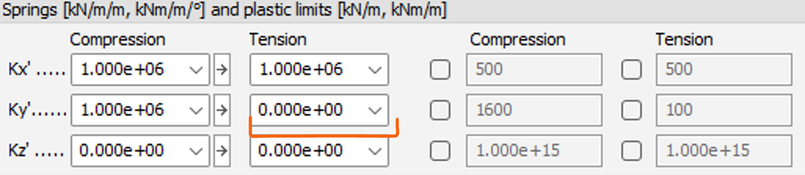
If the Ky' tension stiffness is 0, no tension is allowed, and PREFAB shows a utilization.
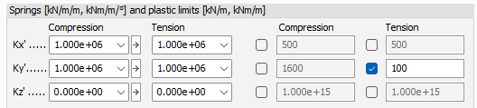
If the Ky' tension stiffness is greater than 0, tension is allowed and there's no concrete check. If a plastic limit is applied, the utilization is:
Compression
The compression capacity is calculated as:
where is the thickness set in FEM-Design, is from the material set in FEM-Design, is from the material's U | Ua, Us setting in FEM-Design and is from the material setting in FEM-Design.
The utilization is calculated as:

Shear of concrete
The shear capacity of concrete is calculated as:
where is the thickness set in FEM-Design, is from the material set in FEM-Design, is from the material's U | Ua, Us setting in FEM-Design and is an effectiveness factor that depends on the National Annex.
For DK:NA:
For all other supported Annexes:
The utilization is calculated as:
Sliding
When Detach is activated on an edge, a combined shear and compression check is activated to check for sliding. The compression and shear of concrete are each checked individually as explained above.
The utilization is calculated as:
where is the friction factor from the edge set in FEM-Design.
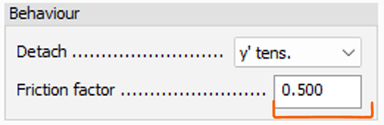
In case , PREFAB will tell you the necessary mechanical anchorage needed to keep it from sliding.
Truss design checks
Plastic limits
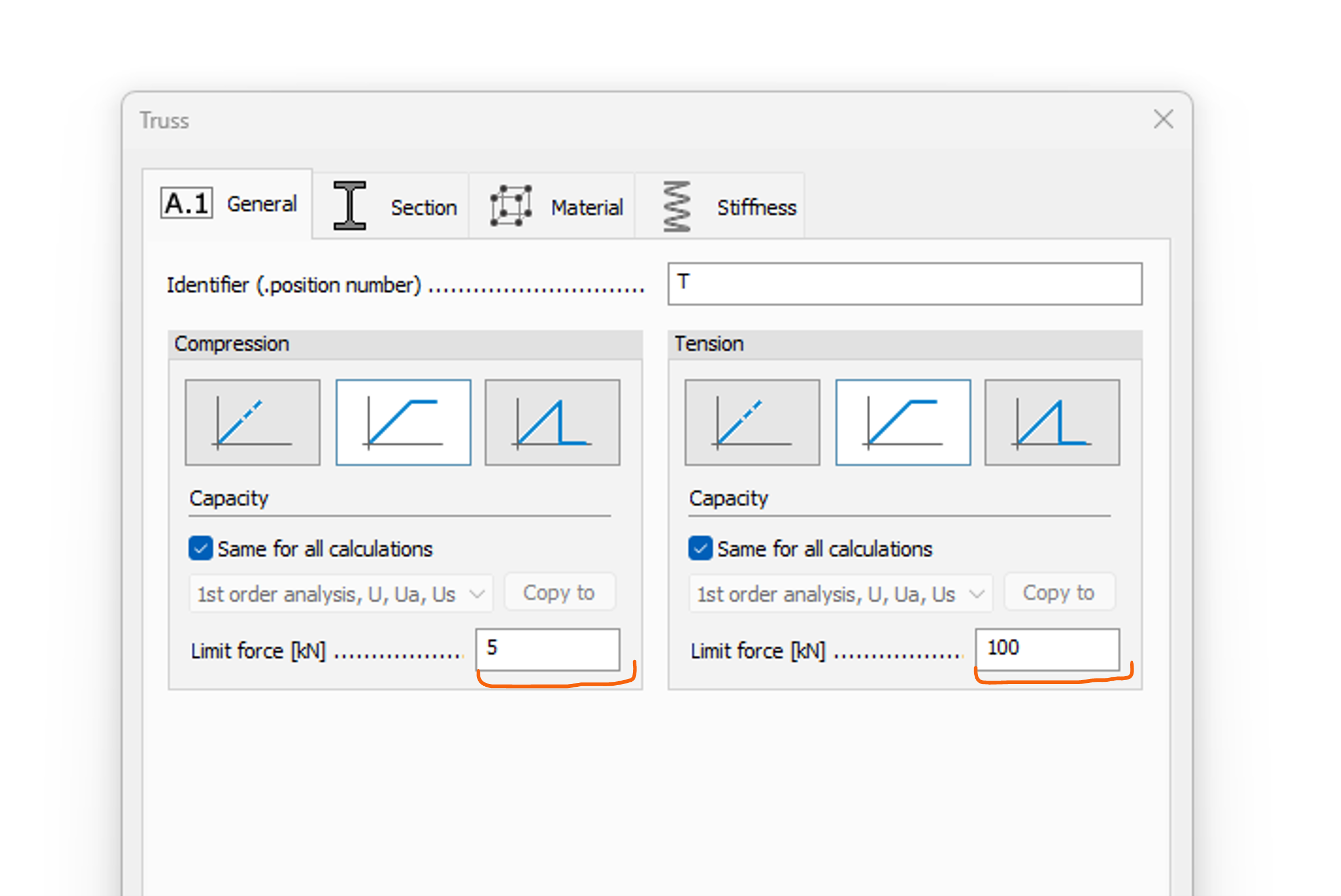
As a rule, PREFAB will always compare the normal forces to the plastic limits defined in the truss properties. For the truss shown below, PREFAB reads the plastic limits as a compression of and a tension of .
Steel truss specific design checks
General information
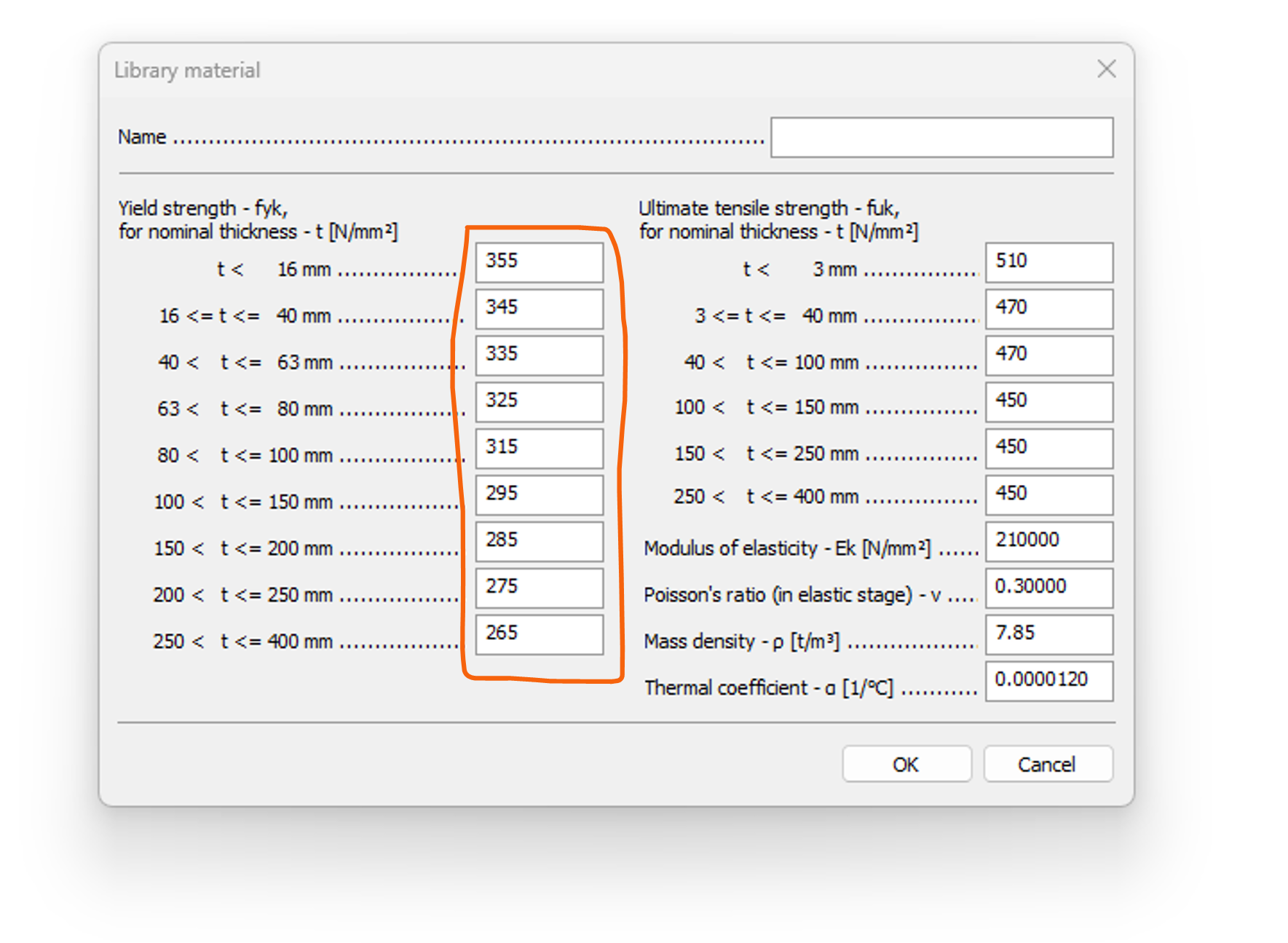
When PREFAB gets the yield capacity of the truss element, it takes the smallest value defined for the material in FEM-Design. You can create a new material and specify the desired yield capacity in all the relevant fields.
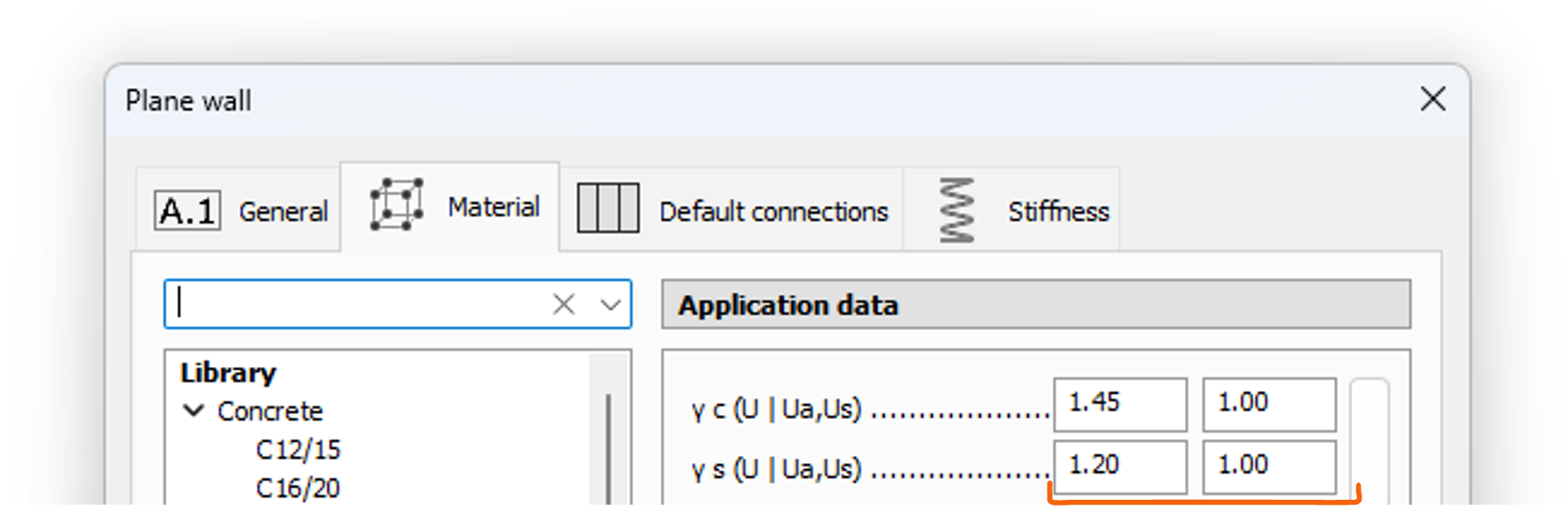
For the design value, PREFAB reads the maximum of the connected shell elements.
Based on FEM-Design: Tension/Compression of steel
The tension capacity is calculated as:
and the utilization as:
The compression capacity is calculated as:
and the utilization as:
New optimized redistribution: Tension and shear of steel
For the optimized redistribution, shear transfer is used if the element can't utilize the friction from compression between the elements alone. In this case, a combined tension and shear check is performed.
The utilization is calculated as: